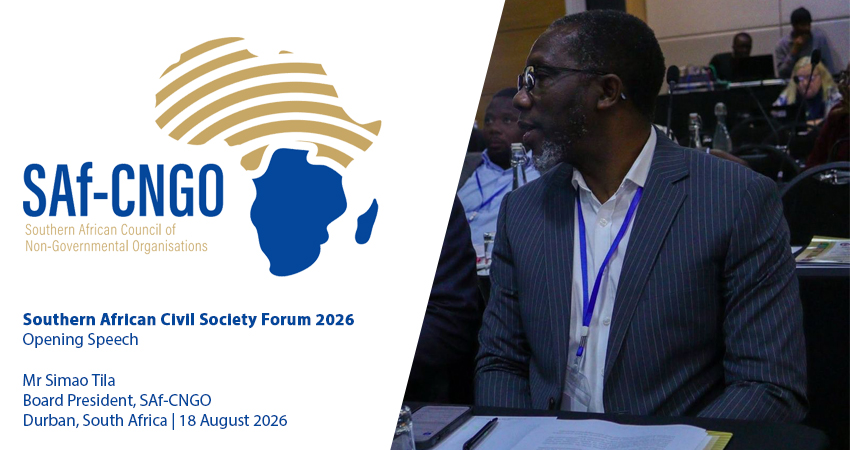
Southern African Civil Society Forum 2026
Opening Speech
Mr Simao Tila
Board President, SAf-CNGO
Durban, South Africa | 18 August 2026
Distinguished partners,
Leaders of civil society from across Southern Africa,
Colleagues and friends,
We gather in Durban at a moment of profound contradiction.
Twenty-five years ago, in this very city, the world adopted the Durban Declaration and Programme of Action. Today that promise remains unfinished. We continue to witness xenophobic violence and the targeting of African migrants. These acts of hatred and collective punishment are unacceptable and must be condemned without reservation.
At the same time, we must speak with equal clarity about the challenge of irregular and illegal immigration. Unmanaged migration places real pressure on public services, local communities, and social cohesion. It undermines the rule of law. A principled civil society rejects both xenophobia and disorder. Sustainable regional integration requires safe, orderly, and rights-based migration governance, not vigilantism, and not uncontrolled irregular movement. This is why the slow progress on the SADC Protocol on the Facilitation of Movement of Persons remains a critical failure.
These tensions sit alongside another growing threat: the organised anti-rights movement advancing a draft African Charter on Family, Sovereignty and Values. This instrument seeks to roll back gains on gender equality, sexual and reproductive rights, and the rights of LGBTIQ+ persons. It is a political project that threatens the Maputo Protocol and seeks to shrink civic space.
Colleagues, we must also address a matter that goes to the heart of our work as civil society in this region: the SADC Non-State Actors Engagement Mechanism.
Article 23 of the SADC Treaty recognises non-state actors as important stakeholders in the implementation of the regional agenda. After years of advocacy, the Mechanism for Engagement was approved by Council in 2022, and Accreditation Guidelines followed in 2024. Yet recent developments give serious cause for concern. Scrutiny by the State Security structures and the Ministerial Committee of the Organ has delayed full operationalisation. The revised modalities now under consideration appear to place greater control over the vetting and accreditation of non-state actors in the hands of Member States. This risks turning what should be a framework for meaningful participation into a gatekeeping instrument.
We are also witnessing a broader regression: the diminishing inclusion of non-state actors in key SADC processes at a time when the region most needs open, critical, and independent voices. A mechanism that subjects civil society to excessive state-controlled vetting, while reducing substantive space for engagement, undermines the very spirit of Article 23 and the vision of people-centred regional integration.
This Forum will therefore dedicate focused attention to the operationalisation of the NSA Engagement Mechanism. We must insist on a process that is transparent, inclusive, and genuinely enabling, not one that narrows the civic space under the guise of security or accreditation.
Over the next four days we will also examine the expanding reach of authoritarianism, climate justice and the race for critical minerals, debt and illicit financial flows, technology-facilitated gender-based violence, the girl child’s right to education, and the protection of human rights defenders.
Colleagues, this Forum must hold competing truths at the same time. We stand firmly against xenophobia. We insist on the rule of law and orderly migration. We reject the anti-rights offensive. And we will not accept the quiet erosion of civil society’s rightful place in regional processes.
Democratic futures in Southern Africa will not be built on denial of these realities. Let us use these four days to sharpen our analysis, strengthen our alliances, and leave Durban with a clear, principled, and actionable agenda.
Allow me to conclude by expressing our sincere appreciation to the partners whose financial and technical support has made this Forum possible. Your contribution is not merely logistical; it is a concrete investment in the space for Southern African civil society to deliberate, organise, and speak with a collective voice.
I thank you!