SOUTHERN AFRICAN CIVIL SOCIETY FORUM 2026 18 – 21 August 2026 | Durban, South Africa
Democratic Futures in Africa: Advancing Accountable Governance, Social Justice, Economic Transformation and Human Dignity in Southern Africa
OPENING REMARKS
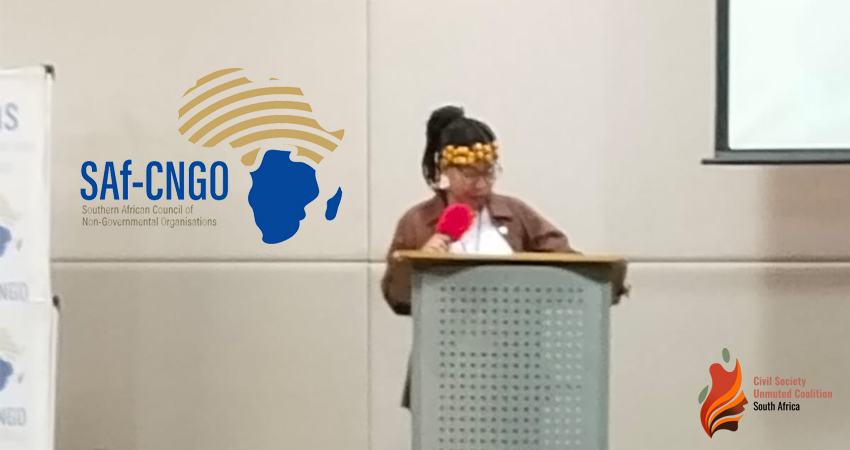
Delivered by: Ms Bandile Mdlalose, Deputy Secretary General on behalf of Ms Cynthia Chishimba, National Chairperson – Civil Society Unmuted Coalition of South Africa
Ladies & Gentleman,
Partners & Colleagues,
Representatives of the Civil Society in Southern Africa and beyond,
Members of SADC-Council NGOs and National Coalitions,
Comrades,
I wish to thank our partners and the organisers of this event for bringing us together and providing us with this opportunity to critically reflect on the challenges we face as the Southern African region and the solutions we as organised civil society have defined for ourselves.
The Theme of this auspicious gathering is:
Democratic Futures in Africa: Advancing Accountable Governance, Social Justice, Economic Transformation and Human Dignity in Southern Africa
I believe that our convenor, the Saf-CNGO, has not arrived at this theme lightly; rather, as the regional body of civil society in SADC, they have clearly and precisely identified the possibilities and dangers we all face at this moment in achieving our shared “democratic futures”
The future has never been more uncertain. We are facing a poly-crisis of intersecting dangers within a collapsing global inter-governmental framework of competition, wars and rivalries between nations. At the same time, global climate disasters impact all countries, while new technologies run away from both governments and society, remaking the traditional economies of our countries. We, as Southern Africa, have old problems, inherited from the past, as we strive to make a better world and a better future in SADC for ourselves, our children and our children’s children.
The Democratic Future is indeed at our doorstep, but so too is the danger of an Undemocratic Present giving way to a nightmare of mutual disintegration in our countries and region.
In these challenging times, we greet you and welcome you to this beautiful city and country! We would have liked to host you under more peaceful circumstances, but we remind you that our nations and our people, despite our current troubles, have a long and shared journey and histories amongst ourselves.
Let us not forget our common history of oppression and brutal exploitation created bonds of friendship, solidarity and humanity amongst our people. While all of us had different colonial masters - Mozambique and Angola had one colonial master; Rhodesia, Botswana, Tanzania, Swaziland and Lesotho had another and South Africa yet another - the hardships were the same. Lest we forget also the co-ordinated and determined collaboration the colonial powers engaged in to protect themselves – from the Smith regime's banditry in Mozambique to Apartheid South Africa’s occupation of Namibia, raids on Botswana, Zambia, Lesotho, its invasion of Angola, etc. The military, political and economic efforts of the settler governments and their allies necessitated a united struggle to defeat them on the part of the people.
Our destinies, our languages, our natural resources, our cultures – all this bound us together from the pre-historic times of the Khoi and the San to the Kingdom of Mapungubwe. The brutality of Colonialism and Apartheid forced us into the same chains of slavery, misery and pauperisation. Our freedom from this tyranny could only be won through solidarity and mutual co-operation. Our destinies have always been shared. Our fate has always been common. Our future remains intertwined, and none of us can thrive without the other. Of the many leaders who sacrificed for our freedom, one who remains highly relevant today is Nelson Mandela. Today I wish to remind you of his guidance and leadership.
His country grapples with the meaning of freedom in the absence of justice. His people contest and are conflicted between the notions of “rainbow” and “reconciliation” on the one hand and the meanings of transformation and fundamental transition from the Apartheid past. The economic powerhouse of the region is weighed down by near-feudal conditions in its townships, its forgotten rural communities and the seemingly endless sea of poverty which South Africans find themselves in.
Speaking to his people after the achievement of democracy, he said, and I quote:
“At the end, the bloodletting stopped. At the end, goodwill prevailed. At the end, the overwhelming majority, both black and white, decided to invest in peace. In the end, it is all this that the ceremonial drums sought to salute as they throbbed to a rhythm both African and universal.
But in the fullness of time, they too ceased to beat. Their powerful rhythms have been replaced by the great pulsations which represent and reflect a new society in formation. New challenges stand ahead of us.
The flame of freedom, under whose light we danced in joyful abandon, has thrown an unrelenting glare on the great human tragedy on which was built the tarnished, tinsel glitter of an unjust society…
As the possibility of nations to become islands, sufficient unto themselves, diminishes and vanishes forever, so will it be that the suffering of one shall, at the same time, inflict pain upon the other.
The new age will surely demand that democracy must also mean a life of plenty…In an age such as this, when the fissures of the great oceans shall in the face of human genius be reduced to the narrowness of a forest footpath, much revision will have to be done of ideas that have seemed as stable as the rocks, including such concepts as sovereignty and the national interest…”
As Mandela said: New Challenges Stand Before Us.
But as we prepare to meet them, we are guided by our not only by history but more than anything by the needs of our people to live in peace and in a world of plenty, where opportunities are shared by all equally.
The vision that we have is not a dream. It is, on the contrary, the only viable path out of hunger, violence, inequality and insecurity. We, the people - mobilised and conscious of our duty to our ancestors, ourselves, our children and our grandchildren - are determined to set a new course for Southern Africa and the continent.
At this crossroads in our history, we set a course for the Rendezvous of Victory, and forever turn our backs on the path that leads to the Dream Deferred.
I thank you,
Cynthia Chishimba
National Chair
Unmute Coalition